 Save
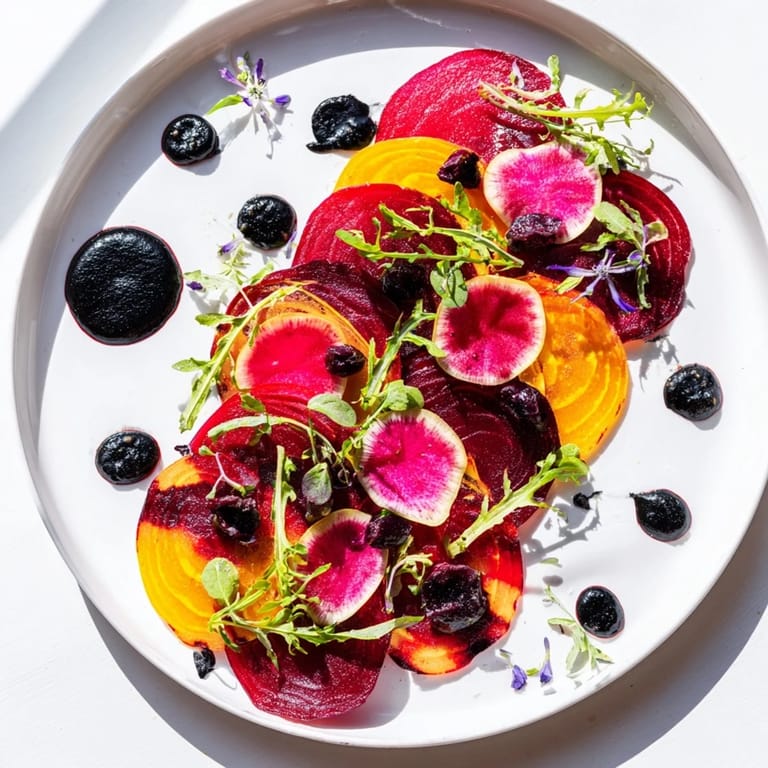
Save I discovered this dish by accident while staring at my farmers market haul one Sunday afternoon, watching how the late autumn light caught the deep purples and golds of freshly cut beets. There was something almost theatrical about arranging them, like I was painting with vegetables instead of brushes. That first attempt taught me that food could be as much about drama and visual storytelling as it was about flavor, and I've been chasing that feeling ever since.
I made this for a dinner party where one guest mentioned she found most restaurant food too precious and fussy. Watching her face when I set down this plate—how her eyes followed the contrasts and shadows before she even tasted it—reminded me that sometimes the most honest cooking is the kind that takes risks with presentation. She had seconds, which somehow felt like the highest compliment.
Ingredients
- Golden beet: Its sweetness forms the warm foundation of the composition, sliced tissue-thin so it catches light like stained glass.
- Red beet: The earthier sibling that deepens the color story and adds an almost mineral complexity.
- Baby arugula: A peppery brightness that cuts through the richness and keeps your palate awake.
- Watermelon radish: Those pale pink and white stripes are the surprise that makes people lean in closer to look.
- Blackberries: They sit in shadow like jewels, adding tartness and visual weight without overwhelming.
- Black olives: Briny punctuation marks that anchor the dark elements and add necessary umami.
- Black tahini: The dramatic final stroke that creates actual shadows on the plate, or make your own by mixing tahini with a touch of squid ink.
- Extra virgin olive oil: Choose one you actually enjoy tasting, because it matters here more than anywhere.
- Lemon juice: The invisible hero that makes every other flavor pop and prevents the whole thing from feeling heavy.
- Honey: Just enough sweetness to echo the beets and balance the acidity, barely perceptible but absolutely necessary.
- Microgreens: The final texture element that makes you feel like you're eating something both precious and alive.
Tired of Takeout? 🥡
Get 10 meals you can make faster than delivery arrives. Seriously.
One email. No spam. Unsubscribe anytime.
Instructions
- Slice your beets paper-thin:
- Use a mandoline if you have one, keeping your knuckles tucked back. If using a knife, angle your blade and let the weight of the tool do the work—these need to be almost translucent to let light pass through them the way you want.
- Create your foundation:
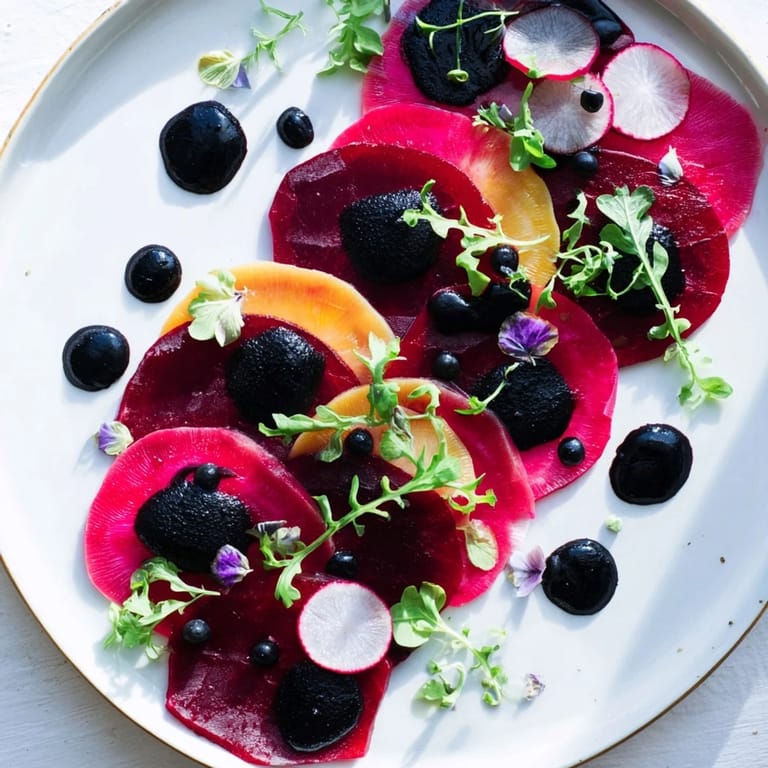
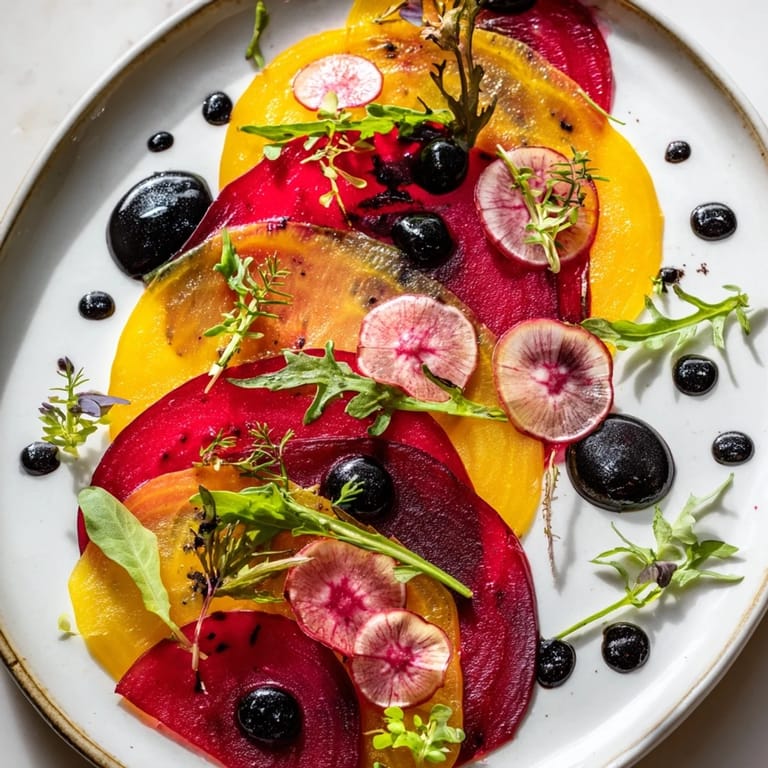
- Lay out your golden and red beet slices in a semi-overlapping pattern on a large plate, alternating colors so the eye can follow the rhythm. Think of it like shingles on a roof, each one slightly covering its neighbor.
- Add the bright notes:
- Fan your watermelon radish slices across the beets, then scatter the baby arugula loosely over top. The arugula should look casual, like it just happened to land there.
- Build the shadow play:
- This is where it gets fun—tuck blackberries and halved black olives strategically behind or beneath your bright ingredients. Position them where they create actual shadows and silhouettes, not just random placement.
- Make your dressing:
- Whisk olive oil, lemon juice, honey, salt, and pepper together until it emulsifies slightly. Taste it and adjust—it should make your mouth water on its own.
- Add the dark drama:
- Spoon small amounts of black tahini around the plate, then use the back of your spoon to smear it gently, creating intentional imperfections that look like actual shadows. Less is more here; you want suggestion, not saturation.
- Finish with intention:
- Scatter your microgreens across the plate and add edible flowers if you have them, focusing on the brightest areas to make them pop even more against the dark elements.
- Serve right away:
- This dish is best eaten within minutes, while the beets are still crisp and everything maintains its structural integrity.
 Save
Save There was a moment during that same dinner party when everyone stopped talking mid-conversation because they were too focused on eating. Not the polite chewing silence of people being well-mannered, but genuine absorption in something that delighted them. I realized then that this dish occupies that rare space where aesthetics and substance merge, where you're not choosing between beauty and flavor but experiencing them as a single thing.
On Mandolines and Patience
If you've never used a mandoline before, this is a perfect reason to finally buy one. The precision it brings is worth it, though I'll admit I spent my first attempt with mine learning respect for how quickly it can catch a fingernail. The key is using the guard every single time, even when you think you're too experienced to need it. Thin slicing is where this dish lives—thick slices lose the elegance entirely and become something more pedestrian.
The Art of Restraint
Making this taught me something unexpected about cooking: that knowing when to stop is as important as knowing what to add. There's a temptation to keep layering ingredients, to fill every empty space, to maximize visual complexity. But this dish works precisely because it knows when it's finished. The negative space on the plate is as important as what's on it. Less garnish, more intention. That's the lesson that matters.
Pairing and Seasonal Thinking
I serve this primarily in autumn and early winter when beets and microgreens are at their peak, though it works beautifully year-round with farmers market treasures. The wine pairing matters more than you'd think—a crisp Sauvignon Blanc lifts the earthiness, while a light Pinot Noir echoes the beet's mineral notes without overwhelming. Think of the drink as another layer of your composition, another conversation partner on the plate.
- In spring, try replacing blackberries with pitted cherries for a color shift that still maintains the shadow concept.
- If you can't source watermelon radish, thin-sliced daikon or Easter egg radishes work beautifully as substitutes.
- Always taste your dressing before drizzling—acidity levels vary wildly between different lemon batches and olive oil brands.
 Save
Save This dish reminded me why I cook in the first place: not just to feed people, but to create moments where beauty and nourishment happen simultaneously. Every time I make it, I remember something different about why it matters.
Your Questions Answered
- → How do I achieve the layered silhouette effect?
Arrange the thin slices of golden and red beets in semi-overlapping layers, then add dark elements like blackberries and olives strategically underneath or behind the bright ingredients for contrast.
- → Can I substitute any ingredients for dietary preferences?
For a vegan version, replace honey with agave syrup. Be mindful of sesame in tahini if allergies are a concern, and olives may contain pits.
- → What tools are needed for preparation?
A mandoline slicer or sharp knife for thin slicing, a mixing bowl and whisk for the dressing, and a large platter for plating are recommended.
- → How long does it take to prepare and assemble?
Approximately 20 minutes to prepare ingredients and 10 minutes to assemble the dish, totaling around 30 minutes.
- → What wine pairs well with this starter?
A crisp Sauvignon Blanc or light, earthy Pinot Noir complements the fresh, layered flavors and dark accents beautifully.